
The Power of Embodied Learning in a Conflict Transformation Cohort
by Jeff Carolin
So often when I support relational mediation processes in workplaces, I realize that the people I’m working with rarely, or never, have had an experience of a conflict shifting from a feeling of disconnection to one of connection – from breakdown to breakthrough. Why then would they believe me that the discomfort of working through a difficult conflict would be worth it?
The importance of the embodied experience of conflict transformation is one of the reasons I’m excited to begin co-facilitating Building Bridges on February 11, 2026, a 7-part bi-weekly learning cohort designed for individuals and teams who want to strengthen their capacity to hold difference, navigate tension, and build trust in their workplaces, social movements, and networks. In this three-month learning journey, the cohort itself will become a practice space for conflict transformation. Let me explain what I mean…
Practicing Conflict Transformation in Real Time
The type of facilitation that we offer will invite each participant’s authentic experience into the (zoom) room. And we’ve found that this process of unmasking – of making our perspectives and experiences visible – will almost inevitably lead to some friction. This makes sense. We’ve all lived different lives, and have different histories, identities, experiences, and traumas. In many workplaces & social movement spaces, when this dynamic emerges, avoidance is the norm. Or sometimes defensiveness emerges, and is perceived by others as an attack. However, when handled well, it is these frictions that actually can become the richest ground for learning and connection.
And so one of our hopes for Building Bridges is that we’ll be able to do what isn’t often possible in our daily lives: notice ouch moments, name them, tend to them, and try again. Conflict, in this way, shifts from an obstacle to a teacher. It reveals the habits we’ve inherited: our patterned ways of protecting ourselves, withdrawing, or reacting; and it also offers a chance to practice something different: to notice our responses, take a breath, and stay present. Rather than just talking about empathy, repair, and accountability, practicing conflict transformation in real time can invite us into a profound embodied experience.
And what’s so key is that once you’ve had that experience, you know in your core that it’s possible elsewhere.
Shared Intentions to Press Pause When our Nervous Systems are Firing
One key aspect of our cohort that will support us to practice this type of real-time conflict transformation is making nervous system self-awareness front-and-centre. This is because one sign of looming disconnection and breakdown is amygdala activation. Our bodies, on some level, perceive a threat (even a very subtle one) in relation to something that is happening in our surroundings and the sympathetic nervous system starts to kick in. And one of the most simple practices that can allow us to catch this before a deep feeling of disconnection and breakdown sets in is this: pressing pause.
In a meeting, this might sound like, “hey, I’m noticing that I’m having a hard time staying focused and listening to everyone, can we slow down for a minute?” Taking a moment to slow down, to name that my nervous system is feeling activated, and to be able to bring a gentle nonjudgmental curiosity to what is happening in the meeting that’s leading to this activation, can often lead to a straight-forward course-correction that allows everyone to continue forward in a good way.
But in spite of this simplicity, on most teams that I’m asked to support this is far from the norm. One reason for this is that it can be vulnerable to ‘unmask’ in front of a team and to reveal that I’m feeling activated. Relatedly, once the flight-fight-freeze-fawn reactive system is starting to engage, we tend to enlist more self-protective behaviours. Speaking honestly and vulnerably can feel especially out-of-reach in such moments – even though this often holds the key to moving out of reactivity.
What can make the power of the pause more attainable is having a shared intention, and culture, on a team that slowing down is welcome. And this is another practice that we intend to build right into the fabric of the learning container we’ll be co-creating with our Building Bridges cohort. We plan to affirm and re-affirm that at any moment anyone can simply ask for us to ‘slow down’, to make visible what’s happening for them. Often all it takes is for one person to actually try this out, and the transformation is felt by all. Once again, the embodied experience of slowing down then becomes the inspiration to bring this practice back to whatever relational context we’re working and living in.
This is Healing Work
In short, I don’t think we learn better together just because it’s “nice” or “collaborative.” We learn better together because transformation happens between us. And it is through this transformation that we have the opportunity to begin re-patterning our relationship with conflict. To practice naming hurt without blame or shame. To experience being seen and forgiven. To build our capacity to stay in connection even when it’s uncomfortable. To see and hold multiple perspectives and complexity.
In this way, I see this type of learning as a form of healing. I really believe that each time we turn towards each other in difficult moments, rather than turning away, each time we practice repair, we are building towards a future in which our systems and movements can envision that it’s actually possible for all beings on this planet to be well and to thrive. It may sound like a big leap, but the sense of possibility that I’ve experienced when a breakthrough happens in a really stuck dynamic… well, it’s really something else.
And now that I’ve set the bar really high, come check out our cohort here.
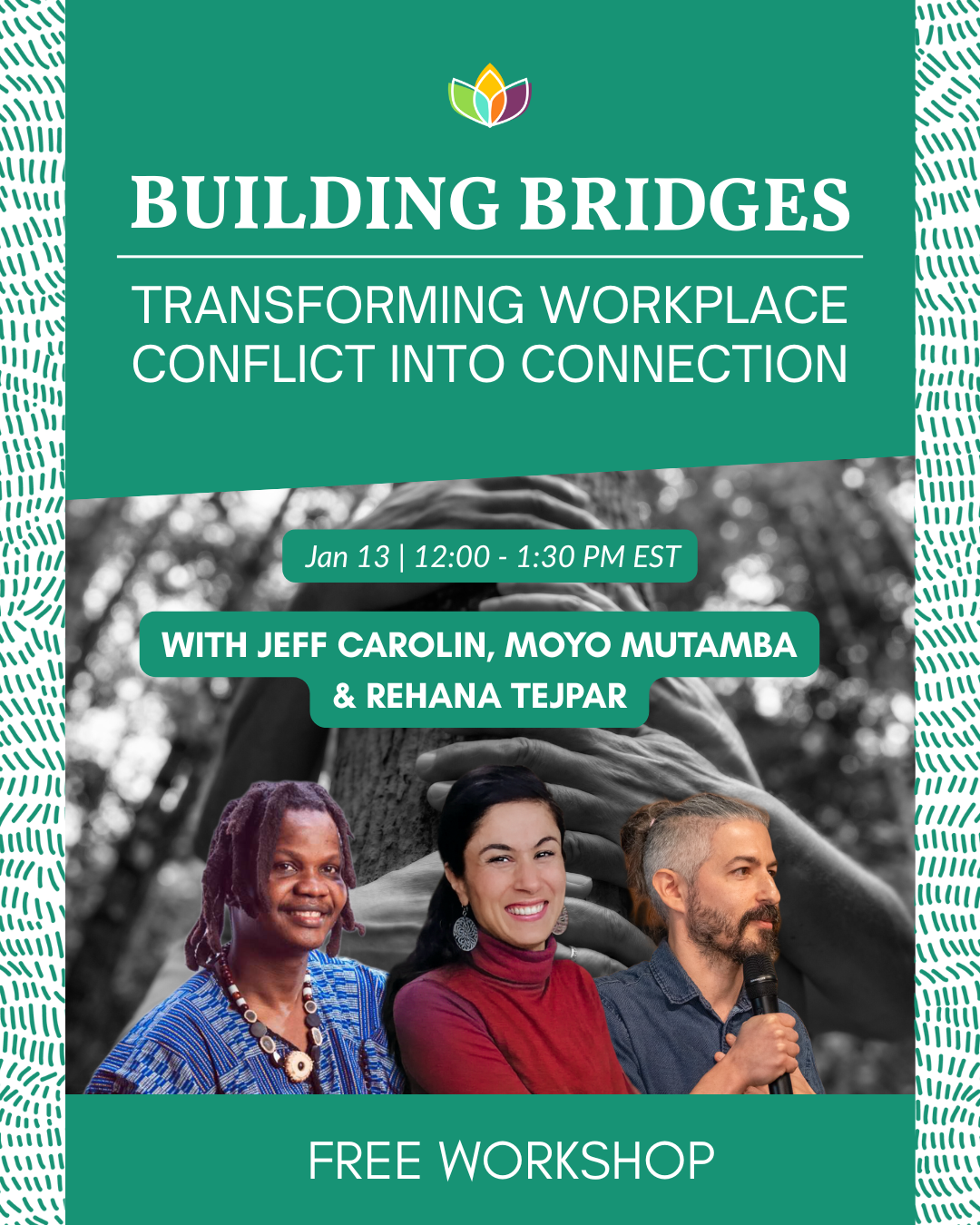
If you want to get a taste of what the cohort will be like, we will be offering a free workshop on Jan 13.